
September 2026


Several species of dove visit our gardens and bird feeders. This is the outer tail feather of a mourning dove (Zenaida macroura). They have long tails that are very pointed, which is unusual among North American doves. The outer tail feathers can be identified by white tips. When a morning dove flies, the white tips look like the decorative ends of a hand-held fan.
We love the sound of mourning doves, and we are happy to find them feeding on sunflower seeds and the millet in the commercial birdseed mix we use. They forage on the ground and clean up seed that has fallen or been flicked out of the feeders by other species.
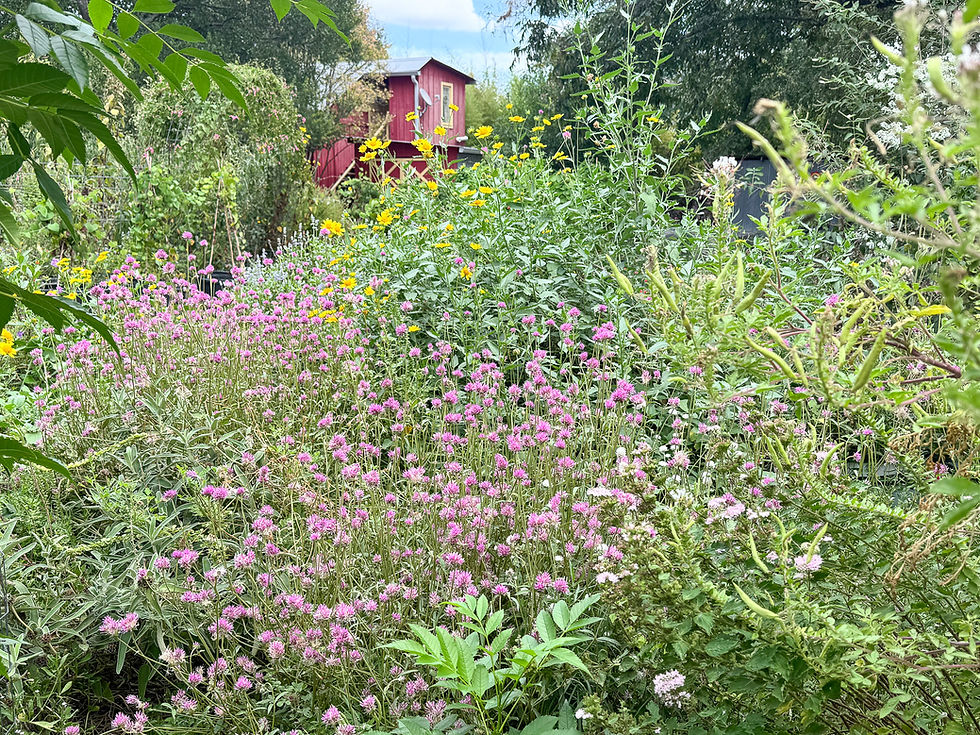
The pollinators visiting our garden this month are feeding on our yellow cowpen daisies, pink fireworks gomphrenas, stinky weed, and sprawling coral vine. We also have Texas Red Sage, Big Red Sage, and Lantana blooming. Many of our zinnia, marigold, and flamingo celosia plants have died back, but we have young plants nearly ready to replace them. It is a lot of work to keep our plants producing nectar-rich flowers before the first freeze.

Firebush (Hamelia patens) is a beautiful perennial that grows into a nicely proportioned shrub. It can take the heat of our Texas summers, and surprisingly it begins blooming during July or August, the hottest months of the year. Like all plants with tubular blooms, hummingbirds find them irresistible. We have one growing in full sun and one growing in partial shade and they bloom equally well. They do go dormant during winter months, so we cut the stems back to about ten- or twelve-inches
September 15, 2026
We are having our giant, old magnolia tree (Magnoliaceae) removed today, after a decade of taking measures to maximize its lifespan. An arborist estimated its age at over 100-years, and we know it existed before WWI because it can be seen as a young tree in historic photos of the home.
It had a good life and witnessed a century of historic events that changed the world. Since the Cretaceous period, Magnolia blossoms have mainly been pollinated by beetles and flies, not bees. This tree provided a unique teaching aid in our garden that will be missed.

We planted several varieties of celosia this year, but none compare to this Cockscomb for beautiful colors and shapes. We don’t plant a lot of celosia because they are not known as productive plants for pollinators. Some celosia cultivars provide small amounts of nectar, so bees will often pay them a quick visit and then move on to richer nectar sources.
On the positive side, this modest food source does produce blooms over a long period of time. Flowers that are tightly packed, like this cockscomb, make it hard for bees to land and even harder for their proboscis to reach the nectar. If we plant a few square feet each year we can visually enjoy their artistic beauty, and the bees can get the majority of their nectar from the surrounding plants.
September 25, 2026
Ignacio and I started driving to Santa Fe, New Mexico on September 20th. We love road trips and this was an exceptional adventure. Our trip got off to an amazing start with lunch at a food truck in historic Fort Sumner which most people know as the spot where Billy the Kid was shot and killed. In Santa Fe, we had incredible meals at Radish and Rye, Izanami, and La Choza, and we spent lots of time at the Georgia O’Keeffe Museum. The highlight of our trip was touring her home, studio, and gardens in Abaquiu, 52-miles from Santa Fe. I had no idea that she was devoted to kitchen gardening as well as cooking, canning, pickling, drying, and freezing her own food. On a weekly basis, she was able to flood her garden with water from a local irrigation system called an acequia.
September 28, 2026
New Mexico experienced downpours and flooding during our visit, and we arrived home on September 28th to find the gardens hot and dry. Luis, Sara, and I have been working hard all summer to keep the everything alive between our infrequent rain showers. For my birthday present, Sara refreshed my hanging baskets with beautiful plants making them colorful for tourists and neighbors who help us celebrate upcoming fall events. I think the chickens enjoy them, too.

We have a checkered garter snake that hangs out in an area of our garden that is teeming with earthworms and small frogs, two of its dietary favorites. We have also seen one swimming in a garden pond hunting tadpoles. Garter snakes tend to be solitary, diurnal, and slightly venomous, but not dangerous to humans. This snake is part of our garden ecosystem.

We have about 250 plants potted that we propagated by divisions, cuttings, and digging (collecting unexpected seedlings that emerge around some of our perennials like Flame Acanthus). We plan to use them in a reclamation garden in an old orchard. This will be an area where we allow plants to grow naturally. We will add compost and natural mulch, but we will not have borders or beds. I’ll include pictures in future entries. We hope to get the new plants in the ground in time for their roots to get well established before the first freeze. Our plastic, portable greenhouses don't have space to winter-over this many potted plants.


Comments